

Programme and portfolio management
In oil, gas and infrastructure EPC projects.
Home · Expertise
Credentials
Claims are easy; that is why the documents themselves are here, so you can see and verify them.
Field of work
In oil, gas and infrastructure EPC projects.
FEED, MDP and change control through to IFC.
Critical path, delay analysis and schedule recovery.
From technical risks spotted at design stage to logging, monitoring and closing them during execution.
In roadmaps, risk identification and stakeholder communication.
Based on the PEB model, and carrying strategic objectives into programmes.
Qualifications
International credentials
One project management certificate and three AI certificates, all from the same issuer. The PMP number and validity are listed so you can verify it in PMI’s official registry.
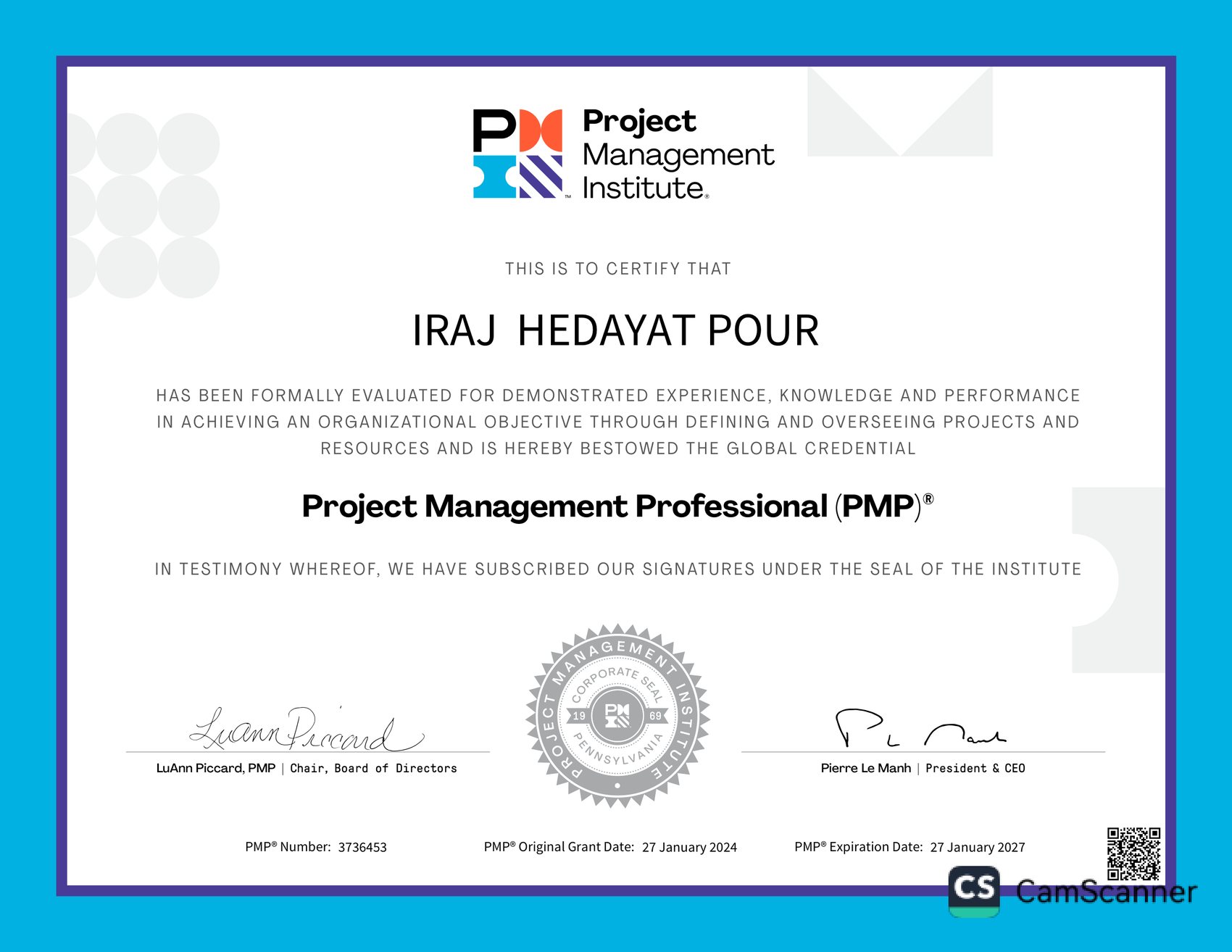 Full view
Project Management Institute (PMI) — USA
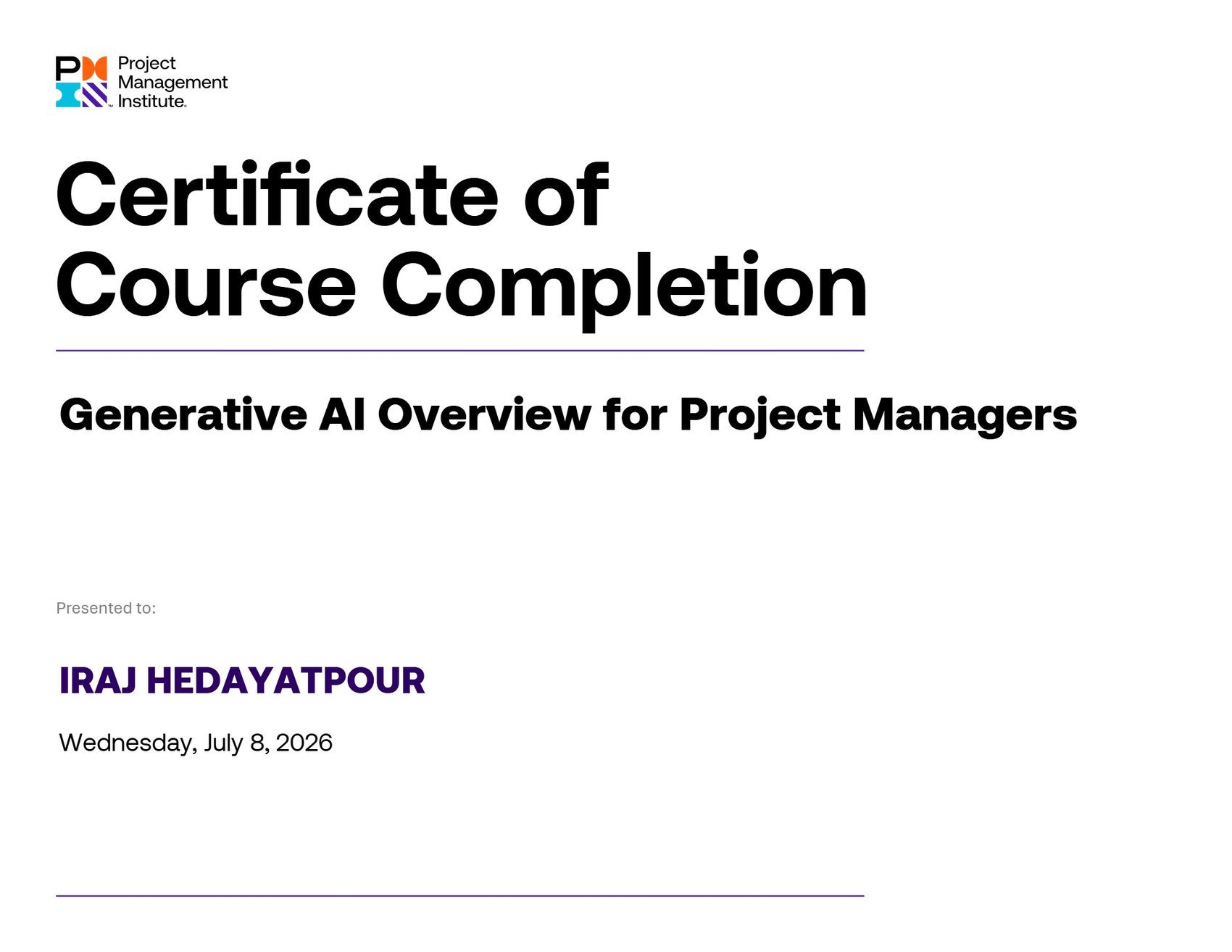 Full view
Project Management Institute (PMI)
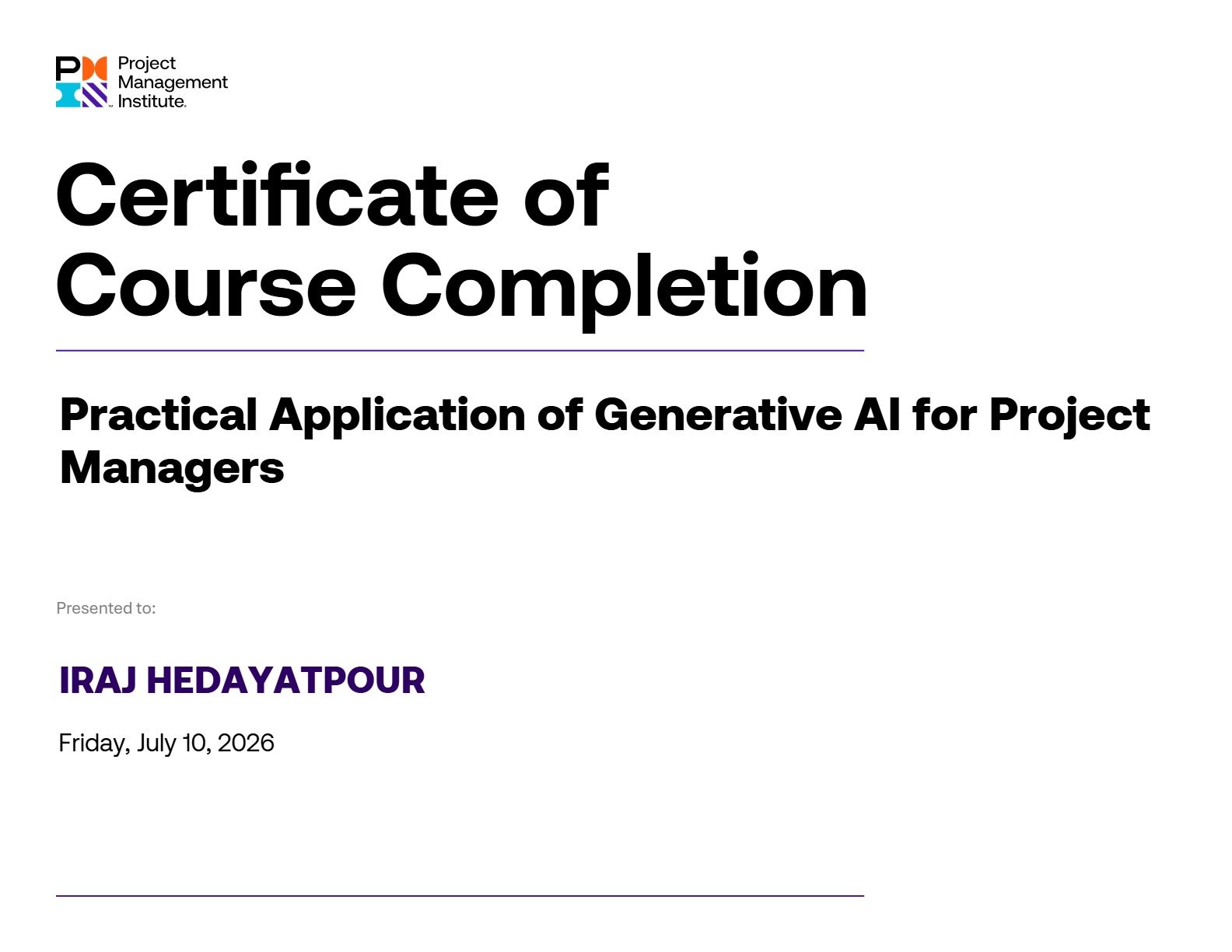 Full view
Project Management Institute (PMI)
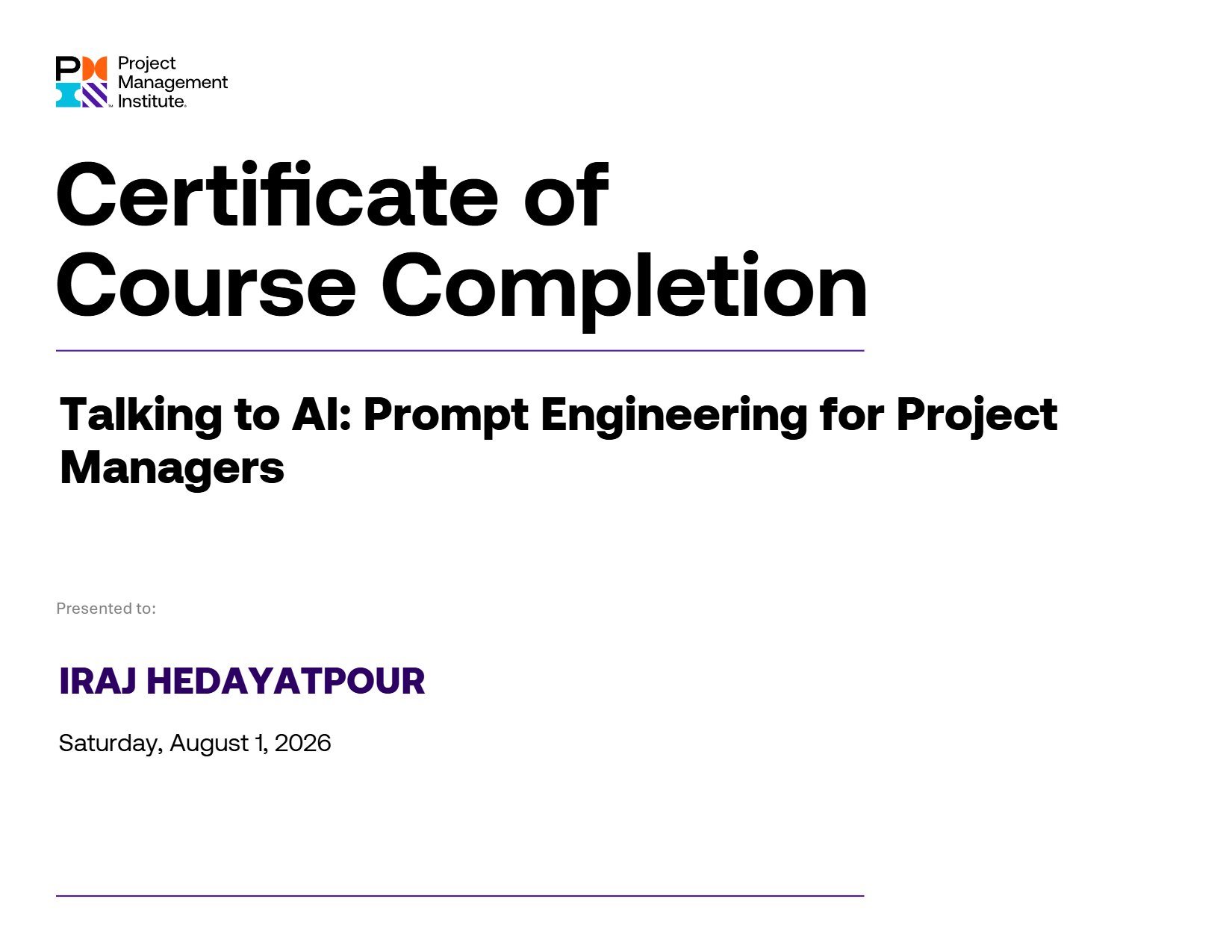 Full view
Project Management Institute (PMI)
AI consulting
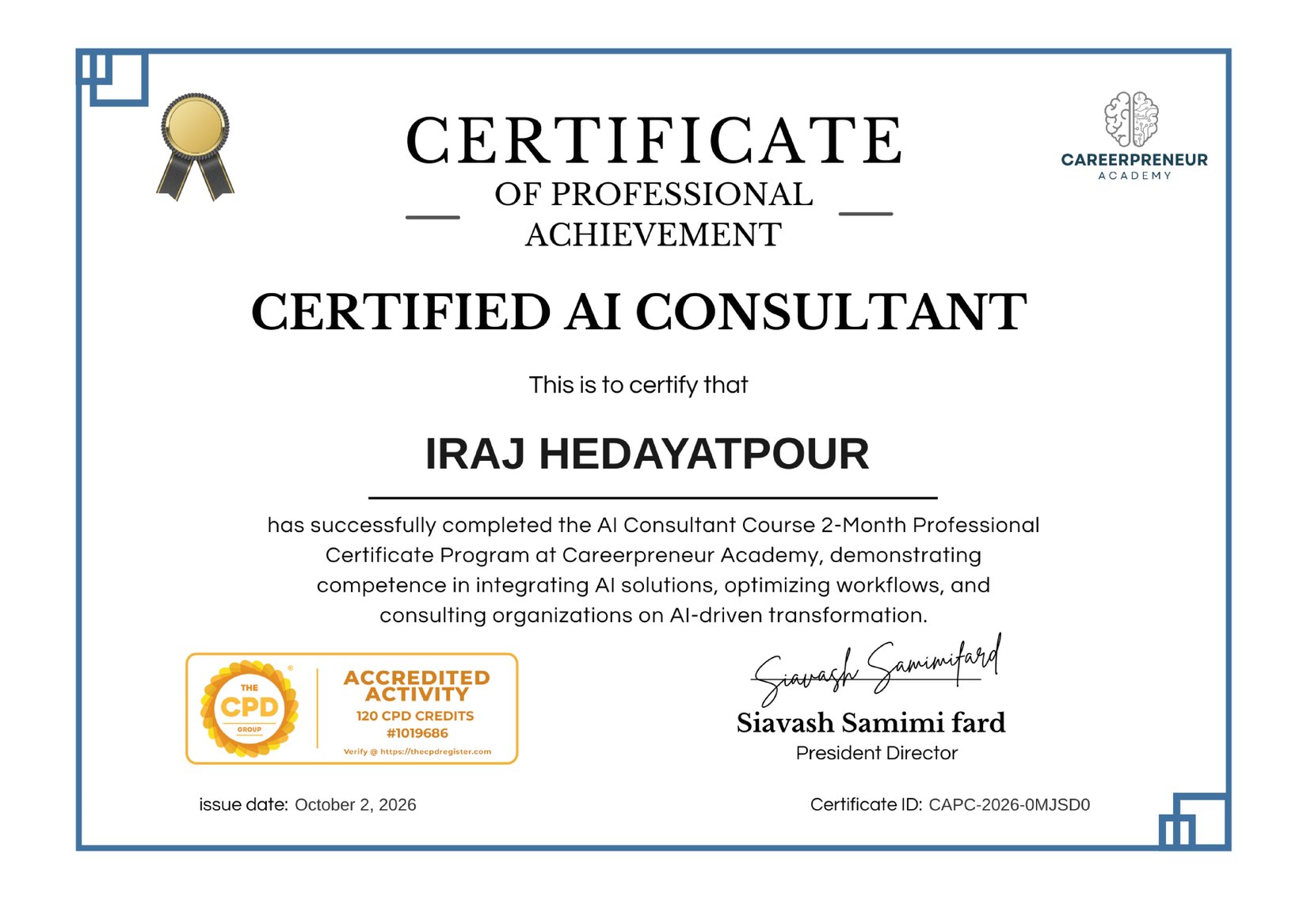
A two-month professional programme worth 120 CPD credits, on integrating AI solutions, optimising workflows and advising organisations on AI-driven transformation. The certificate ID and CPD activity number are listed so it can be verified.
 Full view
Careerpreneur Academy — CPD Group accredited activity
Iranian Project Management Association
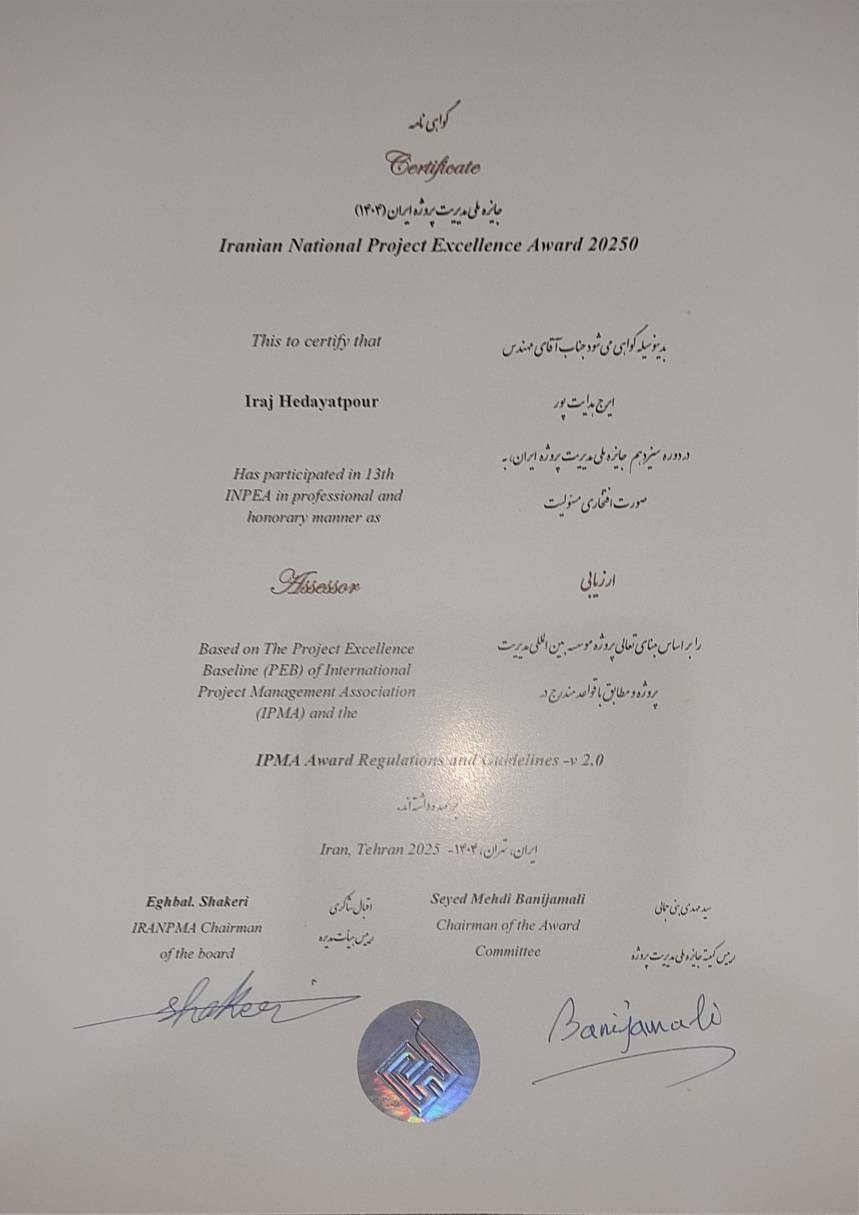
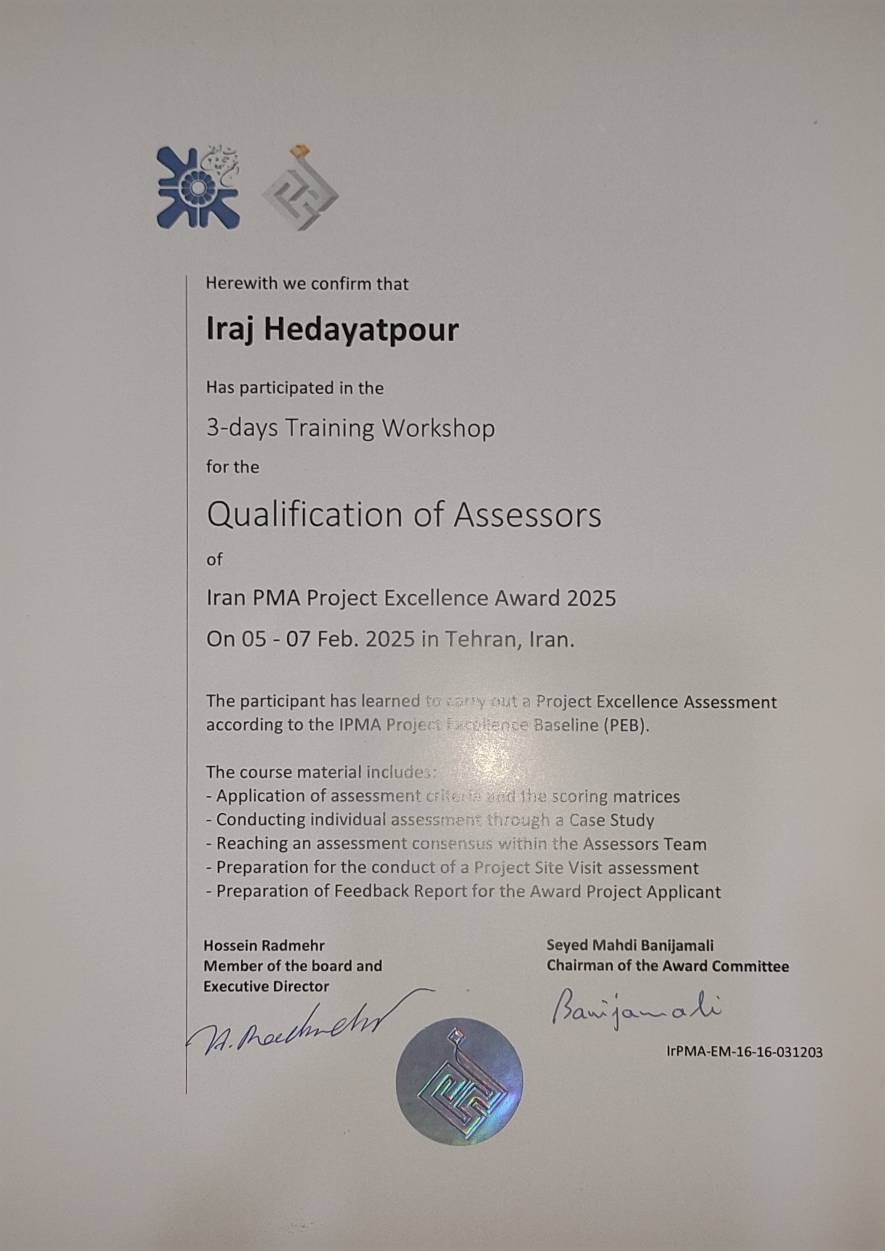
Excellence assessment looks at a project from another angle: instead of running my own project, I assess other people’s projects against a shared, declared baseline. Both documents below rest on the same basis: the IPMA Project Excellence Baseline (PEB).
 Full view
Iranian Project Management Association (IRANPMA) — Tehran, 2025
 Full view
Iranian Project Management Association (IRANPMA) — Tehran
Workshop syllabus
The workshop syllabus is exactly what separates an assessment from a personal opinion: applying assessment criteria and scoring matrices, individual assessment of a case study, reaching consensus within the assessor team, preparing a project site visit, and writing the feedback report for the applicant project.
Delivery methodology
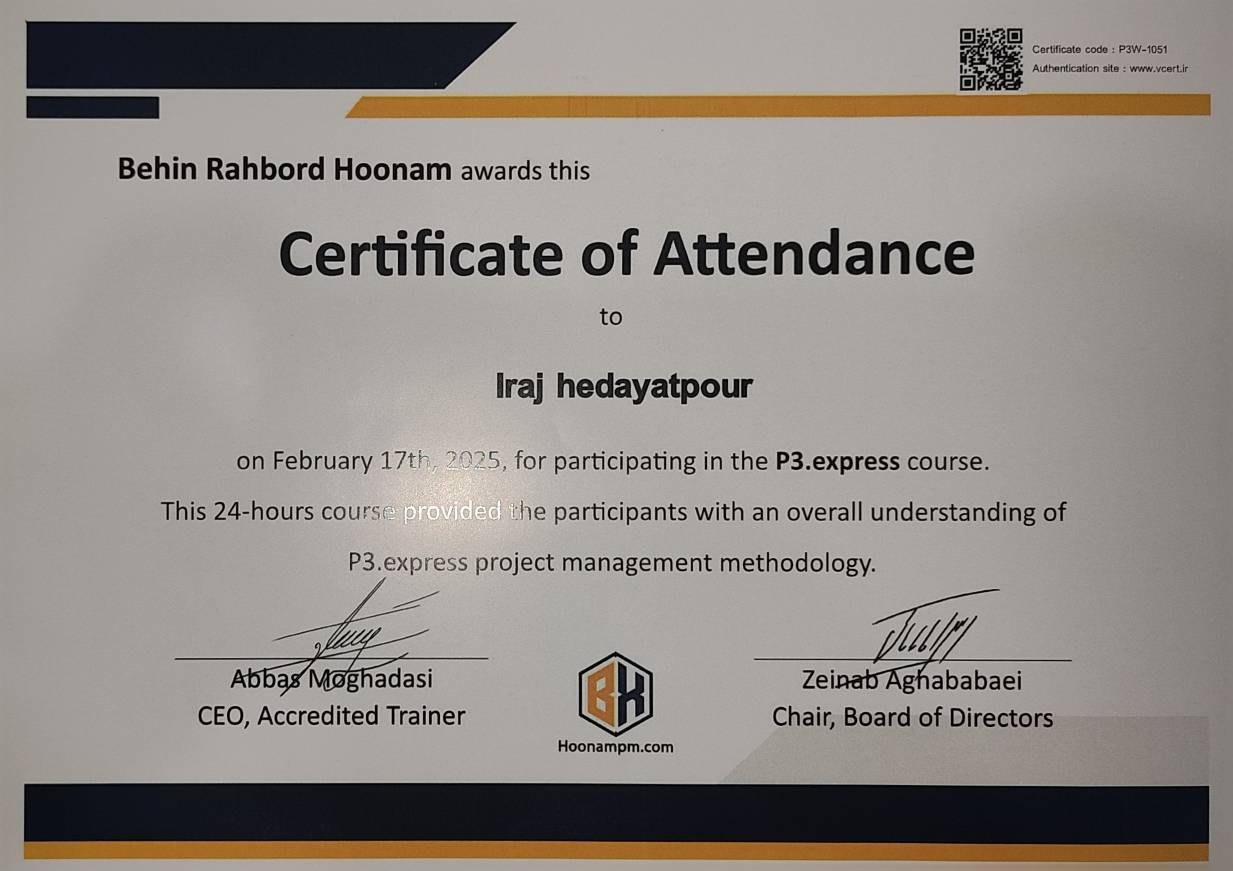
A schedule, however detailed, does not move a project by itself. What moves it is a cycle that asks the same few questions every week and demands the same few outputs. P3.express is a lightweight project management methodology built to do exactly that: a small number of fixed activities set on monthly, weekly and daily rhythms — from start-up to delivery and closure.
Real progress is not discovered in the monthly meeting; it is only discovered late there. With a fixed weekly cycle, deviation shows up in the same week — while it can still be recovered.
A risk register is alive only when it is part of the weekly cycle, not a separate document updated once a month. That is where risk management turns from a file into a practice.
The method asks at set intervals what state the project is in — not just how many percent it has progressed. The difference between those two questions is the difference between a status report and a timely decision.
No item is closed without a named owner and a defined output. The same rule applies in advisory sessions: a meeting ends with a specific action, not a general summary.
On an EPC project
For an EPC project with dozens of simultaneous work fronts, the value of this method lies in what it does not add. A new reporting layer on a project already buried in reports makes things worse; a short, fixed cycle shortens the path to a decision.
That fixed rhythm is what makes AI on the reporting cycle possible: the tool sits on a regular cycle, not on a shapeless flow. A worked example is on the AI page.
 Full view
Behin Rahbord Hoonam — accredited P3.express trainer
Before work reaches the site
Most site hazards are born in the design office.
That is why safety in my work is not a separate item at the end of the report; it is part of planning.
HSE
Safety is not a project cost; it is the cheapest insurance a schedule can buy. An incident on one work front can stop that front for days, and its effect on the critical path costs more than any engineering delay. That is why safety in my work is not a separate item at the end of the report; it is part of planning.
None of these is a slogan. All five are decisions made before work reaches the site.
What it is measured against
A safety claim is credible only when its period, scope and boundary of responsibility are clear. These differ on every project, so I don’t publish a headline number here; in a meeting I give each project’s record with those three qualifiers. A precise sentence is always more credible than a big one.
Bring one specific issue; an hour is enough to start.
Usually replies in a few seconds
Replies are written by AI, so your message is sent to that service; please don’t send confidential project documents or data.